The Joy of Warmth

Winter in 1970’s Britain was grim, not just because of the endless strikes, heartless politicians, cheesy glam bands and creepy disc jockeys but because…it was cold. It seemed to snow more too. Lots of slippery fall on your bum kind of ice. My dad putting socks over his shoes to get to work in one piece kind of ice. Long, dark, harsh, unforgiving winters. Winters of discontent. A decade of discontent. That’s how I remember it. Cold winters didn’t stop in the 70’s. They iced up the early 80’s too.

Around this time, in the early 80’s, I lost count of the number of times we were sent home from school due to burst pipes and malfunctioning boilers. School would shut because of the cold, that’s how cold it was. Unfortunately, it didn’t happen often enough. I’m not sure it was worth the early stages of frostbite. I walked home from freshly closed schools with feet like blocks of ice. Even when I sat with my feet right up against the gas fire, trying to thaw them, it would take at least half an hour before I could feel them again. The numbness was scary. It’s a nasty, queasy feeling when your feet are divorced from your legs. It’s difficult to take your shoes off when you can’t feel your feet. They are heavy and phantom at the same time. Once the shoes were off, it got a little easier. It took another half hour before I could feel my feet. Surprised I didn’t lose a few toes, or a foot or two.

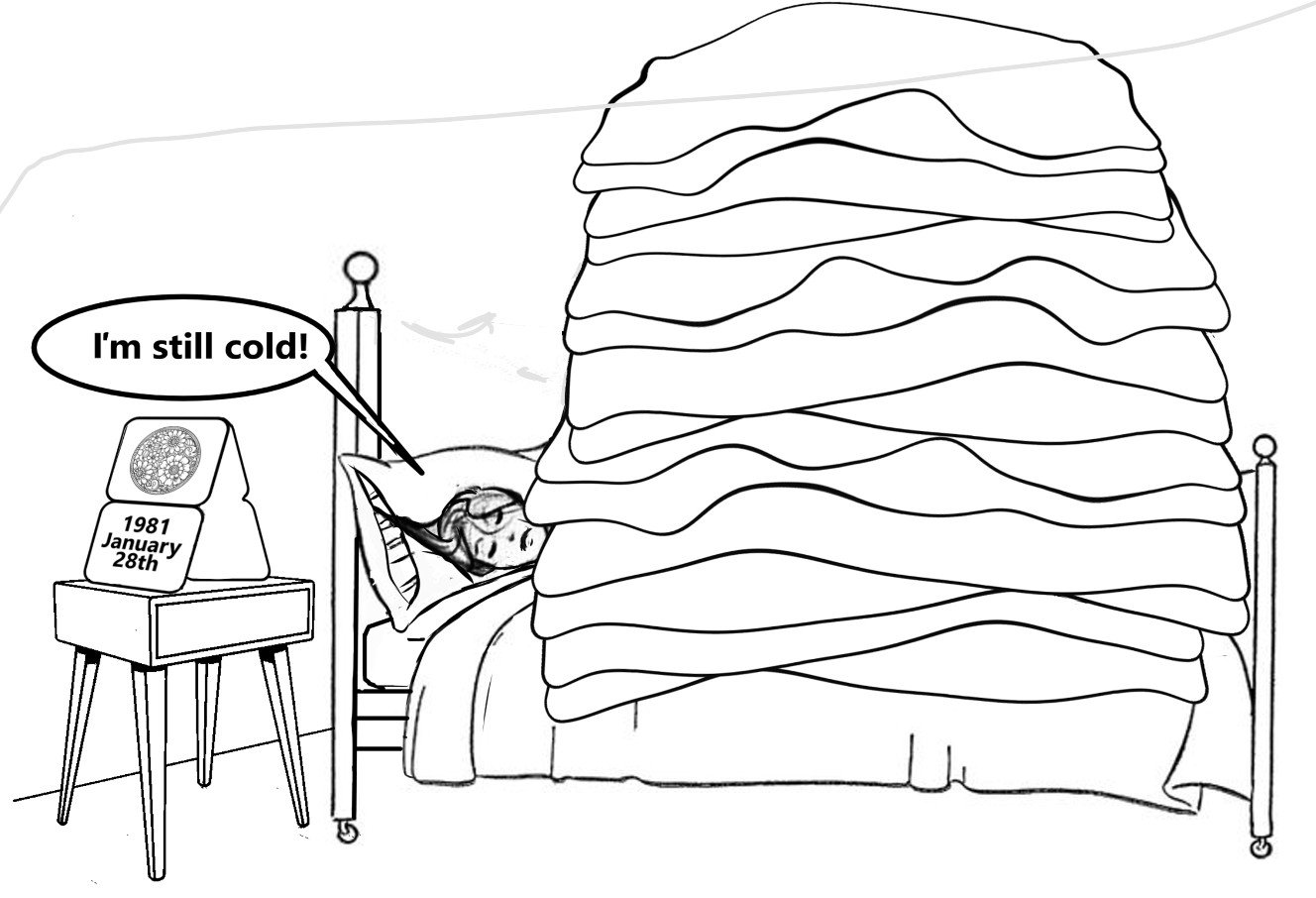
Not quite so scary or dangerous as frost bitten feet, but just as Dickensian, were the nights. We didn’t have central heating. The only heat was in the form of a gas fire in the living room. It was so cold in my bedroom at night, that I used to wear six layers of clothing in bed. Here is what I used to wear on a nightly basis when I was a teenager :

1st Layer -Nightdress

2nd Layer -Dressing gown

3rd Layer- Thin short cardigan

4th Layer -Slightly thicker short cardigan

5th Layer -Slightly thicker cardigan than the last one

6th Layer -Thick, chunky, long Starsky and Hutch style cardigan, with woolen belt.

The bed had about eight or nine blankets on it. There were no duvets in those days, well, not in our house.It was cold but it was a veritable tundra in the nether regions of the bed. My feet could not even dare to plumb the freezing depths, not even three quarters down. It would be like plunging your feet into a cottony fridge. I would say halfway down was the cut off point. I would curl into a foetal position. The feet had to stay high. Difficult when you’re five foot eleven and you have to stay in that position for the whole night.

Maybe sometimes, as the night progressed, the feet would be able to go a little further down. Although it was a slow gradual process, little by little, over time, I could warm up layers of cold further down in the bed. By morning, the conditions down there would be temperate at least, but of course, by then it would be too late. Time to get up.

Some part of me hankers for that, well, maybe not that, but elements of the past simply because I was young and my whole life was in front of me. It’s the past and I’ll never have it again. The past when all said and done can seem safer than the future, no matter how depressing or miserable it seemed. Why would I want that again? I don’t. It’s just that nostalgia can seem fuzzy and warm, despite the cold.

It sounds like I have a cold feet problem but if I did then, I certainly don’t now. Thanks to central heating, hot flashes and thermal lambswool socks, I now have toasty warm feet all day and all night long! Hurrah! A happy ending!
The Joy of Sex Education

There were only two times I remember there being sex education at our school. The first time was in biology class. My biology teacher looked like a cross between Magnus Pyke and Dr Snuggles. He was a decent man and a competent teacher. Normally we talked about animals or plants or we dissected frogs but this day was different.

For reasons I don’t quite understand, to this day, our biology teacher decided to forgo our usual lesson on things like photosynthesis and osmosis and decided to talk about how humans procreate, from start to finish with all the icky bits. Perhaps someone in charge of the cirriculum had decided we knew nothing about sex and needed teaching. We were eleven, so most of us knew something about sex in varying degrees. Maybe he decided to talk about this off his own bat. Was it improvised? Had he been up all night rehearsing? Was this the one lesson in the year he had been dreading for months, or looking forward to?

No. He hadn’t been looking forward to it at all. That fact showed in his whole demeanour. I’ve never seen a man get through a talk with such obvious awkwardness. During some moments, he looked like he was in physical pain.

The lesson stands out for two reasons, the strained seriousness and extreme effort of Pyke Snuggles to convey the basic biological processes of procreation and the doubled over please stop making us laugh, it really hurts now, no seriously, please stop sir, but he wouldn’t. We were not emotionally mature enough for this talk, not in a class setting. I like to think I was. For the first fifteen minutes, I sat there very composed and attentive and straight faced. After a while though, I was as bad ad the rest of them, who were practically rolling around on the floor clutching the stomachs.

It began with embarrassed sniggers but just got worse. Laughter and perhaps embarrassment is contagious. If he only knew, we were in pain too, trying to stifle our laughter but as with all these things, the more you try to stop doing something, the more you sometimes can’t stop doing it. Eventually, we gave in and let it all out. We drowned out his voice with our laughter. Perhaps that was deliberate.

I felt a combination of sympathy and distress for Pyke Snuggles. On one hand, I was sensitive to his extreme discomfort and frequent red face. On the other, I wanted him to continue, as this was the most fun I’d had in years. Even Fawlty Towers didn’t make me laugh this much. It was very conflicting. It was also painful to laugh so much.

At one point, he got cross with us and started shouting. This just made us laugh even more. It was at that point in mirth evolvement when everything he said and everything he did made us explode. We were far too over stimulated to back down now. It was like he was suddenly the best stand up comedian in the world and we’d paid good money to be entertained.

He gave up and we ended class early. As Pyke Snuggles exhausted stooped frame exited the classroom, I couldn’t help thinking he was going for a much earned lie down with a couple of Valium.

Be Slow to Take Offense

‘Let every man be quick to listen,slow to speak and slow to anger.’

– James 1:19

But why is it so difficult to be slow to offend?

What open wounds

Exposed to hot knives

Have taken me there?

The bitter taste

of resentment

Still on my tongue

If pushing my buttons were a sport

I would lose every time.

Each imagined slight

Or real live betrayal

Has no sliver of light between them

They merge

And become one

And all the lines blur

It’s all very well

To advise

But when

that button is

so vunerable…

When it feels like everyone finds it

temptingly delicious to push…

I need to take responsibilty

For how I feel.

‘Human anger does not produce the righteousness

that God desires.’ – James 1:20

I need to understand why it feels how it feels.

It feels nasty, disconnected, like I’m outside myself.

Like I’m not there anymore.

‘Anyone who listens to the word but does not do what it says is like someone who looks at his face in the mirror and after looking at himself, goes away and immediately forgets what he looks like.’

-James 1:23 -24

That’s exactly what it feels like!

Feelings of hurt and anger sometimes makes us feel disconnected.

They alienate us from our our basic selves. But wait a minute, I need hope that I can be slow to offend. Can you give me that?

‘Let perseverance finish its work so that you may be mature and complete, not lacking anything.’ – James 1:4

I get it. Now there is understanding and hope for change.

But where is the unconditional love, where is the hug that I so desperately need?

‘If any of you lacks wisdom, you should ask God, who gives generously to all without finding fault, and it will be given to you.’

-James 1:5

And suddenly all the heat of the anger melts away and in its place is the warmth of the hug.

The Red Cloak

My dad said you should always wear a red cloak to stop people seeing the blood.

I really bought into this idea of his of wearing a red cloak and thereby not allowing people to see blood from emotional wounds. These days I’m not so sure if it’s a good idea. In social situations, in this modern world, the red cloak was meant to stop people taking advantage, to protect us from predators and users. No harm in that. But do we overdo it?

Roman soldiers would wear red cloaks when they marched into battle, believing it would protect them from harm. If the enemy didn’t see the stain of blood on the red cloak, they couldn’t see that you were injured and that may give them the advantage in a battle situation.

Yet the colour red isn’t just about being wounded. It’s also the colour of power and leadership and connected with wealth and luxury.

When Little Red Riding hood wore a red cloak, it was all about innocence, purity, danger and passion.

In Christianity, the red cloak represents the Blood of Christ and the sacrifice He made on the cross.

In terms of the red cloak as self defence, lately I’m seeing a tendency in some people to always be smiling or laughing and acting like nothing can hurt them. Not only does that deplete their mental and physical and emotional energy to breaking point, it makes other people think they are absolutely fine and that they don’t need help from anyone. Some people think they aren’t hurting and can take the knocks and they might even feel free to deal them out. After all, smilers can take it right? After all, the chances are you’re gonna come up smiling, like you always do.

Now that I’m seeing it in others, I can see it in me. When I was young one of my nicknames was ‘Smiler’ but now I’m thinking far from it being an expression of a happy soul, it may have been a trauma response, or as I like to say ‘The Red Cloak Response’, a desperate need not to show the blood for fear of further attacks. After all, I’m pretty sure the wounded gazelle in the savannah does not want the lion to know they are wounded and that makes perfect survival sense to me.

We say about people when they unravel, when they are undone, or are having difficulties that it is a ‘cry for help’, but at the same time, they may also be trying to hide. There is definately some merit in hiding at certain times but when you hide too well and too much, people think you’re okay and that you don’t need help. They may even think you’re thick skinned at best, inauthentic, false or fake at worst. I’ve seen how ‘appearing strong’, i.e laughing things off when you want to cry and smiling when you’re far from it, can backfire. When I was younger, someone once said to me, ‘Everything’s a joke to you isn’t it?’ but it couldn’t have been further from the truth. It was the red cloak speaking. So while we don’t want to appear too vulnerable for very many reasons, some show of vulnerability, at the right time, in the right place, with people you can trust, is actually essential for survival. But this is the crux of the matter isn’t it? How do we know who to trust? It’s not always cut and dried and we don’t want to trust too quickly.

Some of us grew up in environments where we walked on eggshells and it was essential to constipate our feelings in order to placate one or both parents or other family members, or just someone in authority, like a teacher. It could even have been another child who was bullying us. It wasn’t cost effective to show our feelings at the time. So, as a feint, appearing happy or jolly or like we don’t care was preferable to being kicked while we were down.

Far from the red cloak being a defence, it can be a liabilty, if it’s not tempered with assertiveness. Assertiveness is the real red cloak. The red cloak on its own is not enough. It’s all very well to act like we’re invincible, laughing off the insults of others, smiling all the time and generally acting like nothing is wrong but when we don’t show our disapproval at the way we’re being treated, nothing will change, red cloak or not. If we don’t make that change, by either letting someone know they are overstepping boundaries and/or taking advantage or using and manipulating us in some way, the red cloak is really just a costume change. It means nothing. So, there has to come a time when you say I’m not putting up with this or that or a certain unfair situation.

Wear the red cloak by all means, the red cloak has some purpose but it has to be accompanied by expressing yourself when you are feeling used or abused, or simply when you need help, when a situation isn’t right, whether that’s at work, or a friend is taking advantage, or maybe there’s an imbalance in a relationship that needs more balance. Sometimes, just voting with our feet will work, that’s a very powerful message.

So, we have to speak up, whether that’s with our body language, or our tongues or with our silence, or walking away. The red cloak is not going to protect us from anything, although it might may us feel good temporarily. It’s time to let our feelings show and not hide them. Our feelings, rather than being detrimental, give us validity. When we tell people what we’re thinking, or at least show what we’re feeling on some level, people then have to take notice. They then can’t say ‘Well, I didn’t know you felt that way. You never told me,’ or they at least have to acknowledge it on some level. When we hide or wear a red cloak, they may feel they can legitimately turn a blind eye. We always thought red cloak helped but it never has. Time to take responsibilty and give ourselves permission to show our feelings.

The Joy of Escape

A couple of years later, when I was about eight or nine, I was still following my older brother around like a puppy (see Joy of the Tomboy) and he seemed to have got into some altercation with some boys I didn’t recognize and they didn’t seem to be local.
There was also something very serious and grown up about them. They seemed much older than us. They were after my brother for some reason and were not happy. I’m not sure what he’d done, or if he’d done anything or why they were so angry. When I looked around, my brother was gone from my side, he’d disappeared and I was left with five menacing boys, who, after being unable to find my brother, set their sights on me instead and were glowering darkly at me as one force. One of them said ‘That’s his sister.’ Another ordered, in a sinister whisper, while never taking his eyes from mine, ‘Get her.’
My intuitive and instinctive senses told me I was in danger. I don’t think I even waited for them to start running, I was already off down the hill and had passed the park by the time they started coming after me. The thing that sticks in my mind the most is the speed I seemed to be running. I was running like the wind but I could hear them so close behind me, I could hear their feet pounding on
the concrete flags, their flailing arms and hands flicking and brushing against mine as they ran. I could feel their breath on my neck. The blood was pounding in my head. My heart was thumping as if it would burst. I knew I could not let them get me. The entrance to the park was about two hundred yards from my
home. I didn’t have that far to go, so I suppose it was a quick spurt kind of thing. I don’t think I’ve ever ran like that before or since. I sped up the path to my house, got to the front door and when I looked back, the boys had done a U-turn and were gone. I’d outran all five boys. I’d reached a place where they couldn’t
follow. I’d reached sanctuary. I felt such relief. The joy of escape I’ll never forget. Whatever they were going to do, I don’t want to know and I’m glad I didn’t find out because I ran for my life. I’d been in survival mode. It’s not often we escape by the skin of our teeth. It seems that is one of those things you only see in movies and there were so many times before then and after then when I
didn’t escape, or couldn’t escape and that seems to be most people’s reality. But this was one time, just this one wonderful time, I did escape and because of that it really sticks in my memory. And we need to remember those times when we did escape and celebrate them. Needless to say, that was the moment I
stopped following my big brother around.

In the Garden of Grief

In my dream,

just after you passed on to another realm,

God summoned you to my side

You did not allow me to say goodbye

Or give me a chance to say ‘I love you’

You ended it

As you had started it

And how it had always been

I will never see you again

or hear your voice

But in the Garden of Grief

I got you all to myself

and even though God could not make you

tell me you loved me

He made sure I got to say goodbye

and we talked about the past

and times that made us laugh

and we walked together one last time.

The Joy of Sandwiches

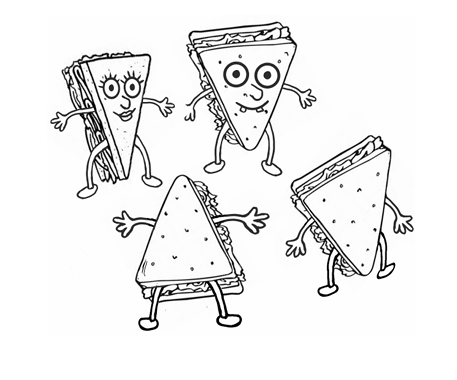
Prepackaged sandwiches have their place
I’m not sure what that place is
A bit like using someone else’s toothbrush
A bit like getting coffee from one of those train station machines
A bit like comparing artificial grass to real grass
Sandwiches made by someone other than you…
…tend not to take the ingredients into the corners.

The ingredients are afraid of
going anywhere near the corners.

We eat them because we have to. We do most things because we have to, because we are railroaded into it.
But there is a way out. Make your own.
Now if you could imagine your very favourite, most delicious dream sandwich, what would it be? Imagine it
and make it. It’s a really easy way to be creative in a basic culinary way.

Cobs from
Kirkby were tough in texture, fresh and crusty and tasty. My mum used to make a great crusty cob sandwich. I find it difficult to get cob buns these days. It’s like trying to find the holy grail. My mother would fill them with a mature cheese, not too strong, with fresh sliced red onion and tomato. The blend and balance of flavours worked perfectly with the feel and flavour of the cob. The cob can take it, so to speak, is designed by its robustness, to take the strong flavours and textures, that thin and limp commercial bread can’t. There is no better sandwich than the cob sandwich. Perhaps the cob is in a different league and comes under the bun heading. There are so many different thicknesses and textures of bread and so many different constitutions of bun that they will all have their different categories and classifications.

It’s not just the sandwich. It’s the wrapping of it. I like sandwiches either loosely draped in foil and then folded into a bread wrapper to keep it all together, or, as an alternative, lovingly hugged by cling film and then put into
the bread wrapper. There has to be two layers. I suppose it goes back to the packed lunch days of my childhood where my mum’s slightly OCD persona influenced the double or triple wrapping method. It was like nesting dolls. The box inside the box inside the box. I think the double wrapping method is sufficient enough and good practice. First there is a hygienic layer like cling film or foil, to protect the sandwich from the elements and to keep it cool and/or fresh. This is followed by a plastic or paper wrapper, which would usually be a waxed bread wrapper, to contain the sandwiches and keep them from wandering off.
Then there might be a third wrapper. You never knew how many layers you had to get through to get to the sandwich. Then there’s the feel of the sandwich. There’s nothing quite like the feel of a good packed lunch. I’m tempted to give the package a good squeeze but just holding it in your hands is good enough. It’s a bit like a soft toy. Firm but cuddly, obviously, don’t cuddle it too much. Nothing worse than squashed sandwiches…although I can turn a blind eye to a warm squashed potted meat sandwich, a sandwich that has had time to marinate, but won’t make you ill, a sandwich that has gone through a certain amount of travel and wear and tear. An experienced sandwich. Of course, we must be careful about how warm a sandwich gets before it is eaten, how far it has to travel etc. they are all variables we have to take into consideration. If I was going on a day/coach trip for example, and the sandwiches in question, as a result, are marinating for several hours before being eaten, I probably wouldn’t have egg mayonnaise as a filling, or fresh ham, especially not chicken or fish or seafood for both spoiling and aroma issues in
enclosed spaces. I think beef might be okay, obviously cheese and tomato would be fine. Potted meat pastes are highly processed, so they may be okay.
There are cool boxes and tupper-ware available but that takes the fun out of the sport. What we want is a sandwich that can stand the test of time, that can go the duration, a kind of superhero sandwich that we can rely on to be edible, tasty and safe, by the time we come to eat it, whenever that may be. A sandwich that comes through for us, in this unpredictable world. After all, if we can’t rely on our home made, lovingly prepared sandwich, which we have researched for durability, endurance, deliciousness and safety etc. what in the world can we rely on?
There is also the foil versus cling film debate. As a child, I would see my school colleagues have either clingfilm encasing their sandwiches, or foil. What is best? Cling film invariably makes sandwiches squashy and sweaty as it hugs them closely. If you want your sandwiches to squash and sweat then this is not a problem. I quite like a squashed sandwich but surely foil is a better option for freshness and coolness. Perhaps this comes down to the time of year. Cling film in winter, foil for summer. I have not fully grasped the advantages and disadvantages of foil and cling film and what is the best wrapping of the two, if any. Whatever is available is usually my motto and if I was cornered, I would probably come out in favour of foil, after trial and error. I think what this all comes down to, is our own personal taste, our sandwich making ability is our last great freedom. We can make a mobile food, investigated, prepared, researched, devised, created and ultimately showcased, perhaps not to the world, but certainly to ourselves and possibly to our friends, family, neighbours.So go on, make those sandwiches, as they may be among the last great vestiges of expressed and tailored individuality that we can seriously enjoy in these uncertain and challenging times.

The Joy of November – Bonfires From The Past


In November, boys would come round in late September, early October
asking for wood for bonfires
And if they didn’t get enough
Sometimes people would find half their shed missing
You had to look after your wood at this crucial time
Treat it like gold
Teenage boys could sniff it out.
Wood, not gold
And there was nothing they wouldn’t do to get it.
It was great if you wanted to get rid of a cabinet
Old bookshelf or table
Then you wouldn’t have to pay someone to take it away
And they would be so happy
You would be doing them a huge favour
But unfortunately, we never had any wood waste
Wood was precious in our home
And my parents would hide from the wood boys
As if they were bailiffs
Turn off the lights and hit the floor
I never saw their joyful little faces as I handed over an old
dresser, or a hefty wardrobe, as we didn’t have any spare oak furniture
to needlessly burn.
These boys would find their own little turf for their bonfire
Have it planned for weeks, possibly months.
‘Bommies’ would be compared with other bommies in other
fields, in other territories.
Pride was taken
Our bommie is bigger than so and so’s,
Our bommie is going to be custy, sound…
The best for miles around
The best in Kirkby
Never understood why they said ‘Bommie’ instead of
‘Bonnie,’ or ‘Bonny’ as in Bonfire. Maybe I misheard and they were saying ‘Bonnie’ or Bonny’
There was a lot that was baffling in those days
And, you just let it go if you knew what was good for you.
Just let the ‘Bommie’ go into the ether. You’re ten years old, the
puzzlement of ‘Bommie’ is the least of your troubles.
I think there may have been mafia like mentalities in the bonfire world at
this time, perhaps boys may steal and sabotage from other ‘bommies’, publicly deride the wood mountain. ‘Our wood
mountain is bigger than yours.’ conversation. The evening
would begin as soon as it got dark. 4p.m is some cases.
It would generally be no later than 6, and that would be considered
delayed gratification. It would generally be all over by 8p.m.

Premature combustion.

Actually, some of the best bonfires would be held back for a little later. 8.30 p.m
but practically all bonfire people would be indoors by 10
p.m or thereabouts because bonfire night has a 5 in 7 chance
of being on a school night. Bonfires would consist of chairs,
tables, wardrobes, bed frames, old Tom’s wooden leg,
anything wooden that was available and probably some wood
that wasn’t. Furniture could be stacked ten, twenty feet high.
It was a creative process. Something fit for The Tate. Try stacking that amount of wood without it falling while retaining an amazing asthetic quality at the same time. Dame Tracey Emin would be proud.

The bonfires, once lit, would create a thick smog that began
at sunset and would hang around until about midday the next
morning. Not many people could afford expensive fireworks
where I lived as a child, so bonfires were the main thing. Most times it
was just a gang of juveniles in charge of a bonfire, but
sometimes whole families and communities would be
involved.
There was a dystopian air, around ten o’clock, long abandoned bonfires still smouldering away, the fog soup
of smoke blurring the night so bad, you couldn’t see your
hand in front of your face, the smell of a burning bombed city
pervading the air for miles around and a strange calm and
eerie silence, that you don’t experience on any other night of
the year. Meanwhile, the formerly impulsive and restless fourteen
year old boys, are now exhausted and slightly smoke
damaged and safely tucked up in bed.
Bangers, unlike sparklers, weren’t pretty but they were relatively cheap. All they did was make a noise like a loud bomb, like a really loud bomb and that was it.
Okay, the children said, that’ll do! That’ll do just fine.
Fireworks are a strange thing. It’s in the word. Hello. Fire.
Works. It says it all. Don’t let them near your pets and
children.
In the 1970’s, 1980’s and 1990’s, young people, i.e
children, were allowed to buy and handle these dangerous
and candy cheap explosives, without any adult supervision.

There were casualities and they would be reported in the newspapers on November the 6th.

I don’t think I’ve seen a
‘bommie’ since 1992, or thereabouts. In the economically
depressed area I grew up in, it was a good thing to have
‘bommies’. They brought the community together, it was
good for neighbourhoods who were able to bond through the
miracle of fire. It was much needed entertainment and light
relief from the daily slug.
As a child, the ‘bommie’ was something I
subconsciously desired and needed, pressing my face up
against the glass for a glimpse of blazing sun in the hopeless
night. Huge bonfires dancing and jumping like fiery Ents
with a troupe of black clothed, hooded teenage boys,
worshipping and dancing around the fiery maypole, like
warlocks, idolising a bonfire which, always seemed to be
about to burn out of control and sometimes did, and the fire
brigade would come out many times that night.
Fire.
Childhood.
A brutal innocence.